
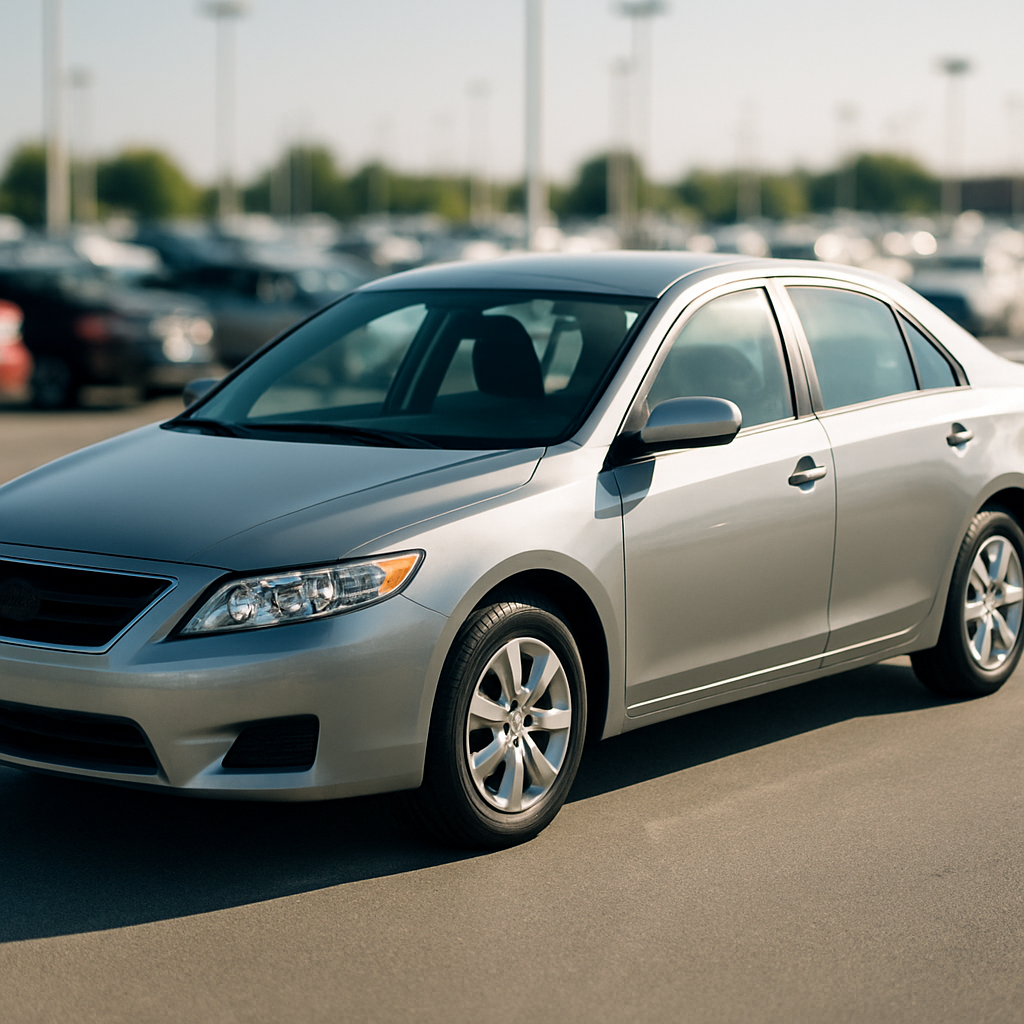
If you’re planning to trade in or sell your car, every visible dent costs you money — usually far more than the repair would have cost. Here’s the real math from Sacramento dealers, what gets deducted for what, and how a $150 paintless dent repair often recovers $500–$3,000 in trade-in value.
How dealers actually price dents into trade-in offers
Used car appraisers use a consistent formula:
- Start with the wholesale book value (Kelley Blue Book or Manheim auction price)
- Subtract reconditioning costs (anything they’ll have to fix before reselling)
- Add a profit margin on reconditioning (typically 50–100%)
- Round down to the nearest $500 or $1,000
So if a dent needs $300 to fix at a body shop, the dealer deducts $450–$600 from the offer. The deduction is always more than the actual repair cost.
Real Sacramento dealer deductions by dent type
From actual trade-in scenarios in Sacramento dealerships:
| Damage | PDR repair cost | Dealer trade deduction | Net loss if unrepaired |
|---|---|---|---|
| Single door ding | $75–$125 | $300–$500 | $225–$375 |
| Medium dish dent | $125–$225 | $500–$1,000 | $375–$775 |
| Crease dent | $250–$450 | $1,000–$1,800 | $750–$1,350 |
| Multiple door dings (3–5) | $200–$350 | $800–$1,500 | $600–$1,150 |
| Light hail damage | $400–$900 | $2,000–$4,000 | $1,600–$3,100 |
| Body line dent on body panel | $200–$400 | $1,000–$2,500 | $800–$2,100 |
| Tesla / aluminum door dent | $175–$325 | $1,500–$3,500 | $1,175–$3,175 |
In every category, the dealer deduction is at least 3x the PDR cost. The math is overwhelmingly in favor of repair-before-trade.
Why dealers over-deduct so heavily
Three reasons:
- They have to use body shop pricing, not PDR pricing. Most dealers’ reconditioning departments use body shop methods because they’re set up for repaint. PDR isn’t part of the in-house workflow.
- They build in margin. A dealer would rather deduct $1,500 from your offer than absorb a $300 fix and gamble on resale.
- They’re guessing. Appraisers don’t have time to get exact PDR quotes during an appraisal. They estimate high to be safe.
This means there’s a structural opportunity: if YOU pay $150 to PDR-fix the dent before showing up, the appraiser sees a clean panel, and your offer comes in at the full book value.
Carfax and paint history — the silent valuation hit
Even after a body shop repair, your car loses value because the panel is no longer original. Used-car appraisers use paint depth gauges to check for repainted panels. A repainted panel is recorded in Carfax (if the repair went through insurance) or detected at appraisal.
The valuation impact of body shop repair vs PDR:
- PDR repair: 0% impact on trade-in value. Factory paint preserved, no Carfax record, panel passes paint-depth check.
- Body shop repair: 2–5% reduction in trade-in value even after the repair is “complete.” Repainted panel visible to appraisers.
- Body shop repair on Tesla/aluminum: 5–10% reduction due to higher paint-history sensitivity in the EV/luxury market.
On a $25,000 car, that’s $500–$1,250 in additional value preservation from choosing PDR over body shop repair. Multiply by the impact on a $50,000 Tesla and PDR saves $2,500–$5,000 in trade equity.
Real customer examples from Sacramento
Example 1: 2021 Honda Pilot, 2 door dings
- Original trade offer at Roseville Honda dealer: $24,200 (deducted $800 for the dings)
- PDR repair cost: $165
- Re-offer after repair: $25,000
- Net gain: $635
Example 2: 2020 Tesla Model 3, hail damage on hood
- Original trade offer (with damage): $24,500 (deducted $3,500)
- PDR aluminum hail repair: $850
- Re-offer after repair: $28,000
- Net gain: $2,650
Example 3: 2019 Ford F-150 (aluminum), 4 bed dents from a fleet job
- Original trade offer: $26,000 (deducted $2,000)
- PDR aluminum bed repair: $425
- Re-offer after repair: $28,000
- Net gain: $1,575
When dent repair isn’t worth it for trade
A few honest cases where leaving the dent might make sense:
- Very old, low-value cars. If the car is worth $3,000 and the dent deducts $500, but the repair costs $200, the math still favors repair. But if the dent deducts $200 and repair costs $200, just trade it as-is.
- You’re junking the car. Junk yards don’t care about cosmetics. Selling for scrap or to a “we buy any car” service — skip the repair.
- Body-damage dent (cracked paint, torn metal). The dealer deducts the same regardless of repair, because they’d need to repaint anyway. Repair only if you want to drive it longer.
For 90%+ of trade scenarios, the math favors PDR repair before trade.
Private-party sale — even bigger value impact
Private buyers are more aggressive about dent-based price negotiation than dealers because they’re paying their own money. A visible dent on a private-party listing typically results in:
- Listings get fewer responses
- Responses start with lowball offers (“$3,000 below asking because of the dent”)
- Buyers expect the dent deduction to be 2–4x the actual repair cost
Selling private with even one visible door ding on a $20,000 car typically costs you $800–$1,500 vs the same car without dings. PDR fixing for $125 nets you $700–$1,400.
The dealer’s playbook (what they’re actually doing)
Inside the dealership, when your car comes in for trade appraisal:
- Appraiser walks the car and notes every dent, scratch, and curb rash
- They photograph each issue
- They run the VIN through Carfax and AutoCheck
- They look up wholesale value (Black Book or Manheim)
- For each cosmetic issue, they apply a deduction from their internal reconditioning schedule (which is body-shop-priced, not PDR-priced)
- They present a number lower than what they’d offer for the same car without cosmetic issues
You almost always have leverage at step 6 to push back on specific deductions — but you have much more leverage if you’ve already repaired the issues and there’s nothing to deduct.
How to maximize trade value
- Repair visible dents with PDR before showing up. Door dings, dish dents, creases, hail — all the PDR-fixable categories. Full dent type guide.
- Wash and detail the car. Sounds obvious but the appraiser’s first impression sets their dent-hunting energy level. Clean car = less deep inspection.
- Get a Carfax report for yourself first. If there’s old damage on the report, know what they’re going to see.
- Get quotes from multiple dealers. Trade-in numbers vary significantly between dealers, especially across different brands.
- Time the trade. Late month-end and quarter-end, dealers are more aggressive on trade-in to close inventory deals.
For Sacramento dealers reading this
We work with multiple Sacramento dealerships on volume PDR pricing for trade-in prep. Used car managers who use us on trade-ins consistently report higher reconditioned-margin and faster turnaround vs sending the same cars to body shop. Get in touch if you’d like to discuss a dealer account.
Frequently asked questions
Will a dealer take my car if it has a dent?
Yes — dealers take cars with dents all the time. They just deduct the value. The question is how much they deduct vs how much the repair would have cost.
How much does a dent decrease my trade-in offer?
Typically 2–5x the actual cost of repair. A $150 PDR-fixable dent costs you $400–$750 in trade value.
Should I fix dents before selling on Craigslist or Facebook Marketplace?
Yes — private buyers are more aggressive about dent negotiation than dealers. The math is even more favorable for repair-first private sales.
Does paintless dent repair show on Carfax?
No — PDR done out-of-pocket doesn’t generate Carfax records. Even insurance-covered PDR (like hail damage) shows as a “weather event” not as “body damage.”
What if I’m leasing the car?
Lease return inspections are very strict about cosmetic damage. Most lease companies charge $500–$1,500 per visible dent at turn-in. PDR repair before turn-in is almost always cheaper than the lease fees.
Trade-in coming up? Text a photo of any dents to (916) 585-2554. We’ll quote the repair cost, and you can compare it to what the dealer would deduct. Most repairs happen the same week, in your driveway, with factory paint preserved.
Related reading: Returning a leased vehicle? See how to fix dents before your lease return and avoid excess wear-and-tear charges.

)
[…] You plan to sell or trade it (a botched DIY repair lowers value more than the original dent — see how dents affect trade-in value) […]