
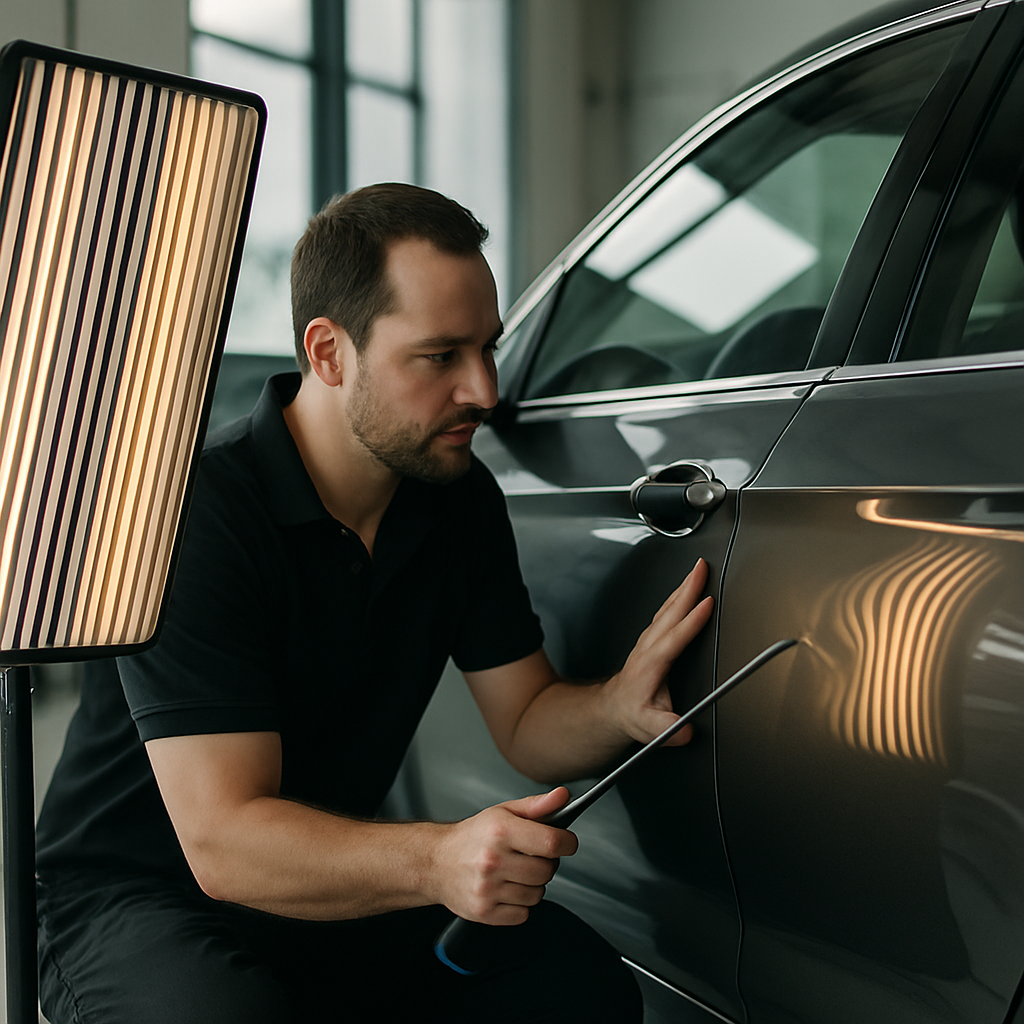
Paintless dent repair (PDR) looks like magic. The tech shows up with a small toolkit, spends 45 minutes at your car, and the dent is gone — with the original paint completely untouched. No body shop, no sanding, no painting.
It’s not magic. It’s metal-forming work that’s been around since the 1940s, refined into a precision craft. Here’s how it actually works.
What is paintless dent repair?
Paintless dent repair is a method of removing dents from a vehicle’s body panel without repainting, filling, or sanding. The technician uses precision tools to gently push, pull, and reshape the metal from behind the panel until it returns to its original factory contour.
The key insight: when a car panel gets dented, the paint usually stays elastic enough to follow the metal. As long as the paint isn’t cracked or chipped, the metal can be returned to its original shape and the paint will look exactly as it did before the dent. Nothing is added, nothing is removed. The same atoms of paint that were on your panel before are still there after.
The physics — why it actually works
Modern automotive paint is engineered to be flexible. A factory paint job has a primer layer (bonds to metal), color coat (the actual color pigment), and clear coat (the protective shine layer) — total thickness around 100 microns, or about the thickness of a human hair.
When a small dent forms (a door ding, a hail dent), the underlying metal deforms, but the paint just flexes with it. The paint stretches slightly on one side of the dent and compresses on the other. It doesn’t crack as long as the deformation is gradual.
If you can return the metal to its exact original shape, the paint returns to its exact original surface. That’s the entire principle of PDR.
The 6-step PDR process
Step 1: Assessment
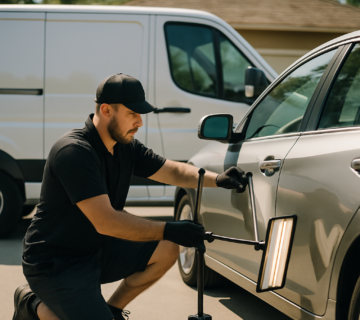
The tech inspects the dent under a specialized PDR light — a long fluorescent or LED tube positioned at a low angle. This makes any deformation in the panel cast a shadow, showing the exact contour of the dent (which is often very different from what your eye sees in normal light).
The tech determines: how big is the dent really, how deep, is there any paint cracking, is the metal stretched, where can we access it from behind. This 5-minute assessment dictates the entire job.
Step 2: Access
To push the dent out from behind, the tech needs to access the back of the panel. This is one of the biggest challenges of PDR — modern cars are designed to be hard to disassemble.
Common access methods:
- Through the window frame (door dents) — remove the inner door panel or work around the window glass
- Through the speaker opening (rear quarter panels)
- Through the trunk (decklid dents)
- Under the hood (hood dents — usually easiest)
- Through the wheel well (fender dents — access via lining removal)
- Through the roof rail (roof dents — hardest, requires specialized tools)
For some dents, the tech can reach in through an existing factory opening (a body plug, a clip hole). For others, a small access hole has to be drilled in a hidden location and plugged invisibly after.
Step 3: Reading the metal
Before any pushing happens, the tech reads the dent. Every dent has high points and low points, sometimes hidden secondary deformations, and a specific “memory” of how the metal wants to spring back.
The tech maps out a plan: which point gets pushed first, in which direction, how hard, and which surrounding points need to be tapped down or worked simultaneously. This planning step is what separates a great PDR tech from a mediocre one.
Step 4: Working the dent
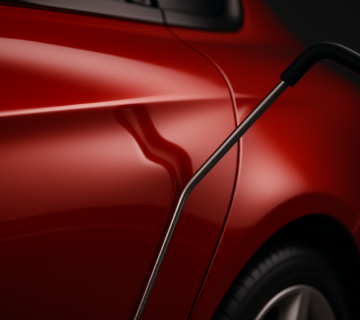
Using a long, specialized rod — sometimes a meter long, designed to reach from the access point to the back of the dent — the tech places the tip on the precise low point and pushes gently.
“Gently” is key. PDR tools transmit very small, precise force. If you push too hard, you create a “high spot” — the metal pops past flush and now there’s a bump. If you push too little, the dent stays.
The tech watches the panel surface under the PDR light. As the metal moves, the shadow pattern changes. The tech pushes a tiny amount, checks, pushes more, checks, until the panel surface looks perfectly flat under the light.
For larger dents, the tech alternates between pushing the low spots and tapping down any high spots that appear during the work. This is iterative — push, tap, push, tap, dozens of cycles for a single dent.
Step 5: Final shaping
As the dent gets close to flush, the tech switches to smaller, more precise tools — tiny tips for fine pressure, “tap downs” for high points. The goal at this stage is not just to make the dent invisible to the eye, but to make it disappear under the PDR light from any angle.
A PDR repair that looks perfect in normal light but shows under PDR light at certain angles isn’t a finished repair — it’ll look wrong in different lighting conditions later (sunlight, garage light, rainy day). A finished PDR job is invisible under every angle of light.
Step 6: Quality check + cleanup
The tech moves the PDR light to multiple angles, checks for any remaining shadow, and either approves the panel or goes back to step 5. Once clean, the tech reassembles whatever was opened for access (door panel, trim piece, body plug), and the panel is done.
Total time: 30 minutes for a small door ding, 1–2 hours for a medium dish dent, 3–4 hours for a complex crease or hail-damaged panel.
The tools — what’s actually in a PDR kit
A working PDR kit includes:
- Rods of varying length and tip shape — the primary push tools. A pro carries 40–100 of these in various lengths from 6 inches to 4 feet, with different tip diameters, angles, and curvatures.
- PDR lights — specialized lighting that reveals deformation through reflection patterns.
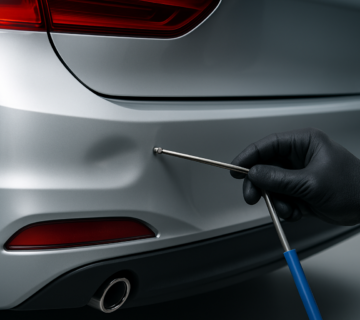
- Tap downs and knock downs — small tools for pushing high spots back flush from the outside.
- Glue tabs and glue puller — for the relatively rare case where the panel can’t be accessed from behind. The tech glues a tab to the dent and pulls it out from the outside (less precise; used as a last resort, not as a primary method like cheap shops do).
- Heat gun — for thermal control on aluminum panels and stretched metal.
Why PDR preserves your factory paint
This is the single most important business case for PDR over body shop repair.
A factory paint job is cured in a heated booth at around 280°F for 30 minutes. This produces a paint film that’s harder, thicker, and bonded more tightly than anything a body shop can apply at room temperature with portable curing methods.
The result: factory paint resists chips, scratches, UV fade, and chemical exposure better than body shop paint. Used car buyers, dealers, and paint-depth gauges can tell the difference.
PDR removes the dent without touching the paint. Your factory finish stays exactly the way it left the factory, and the panel passes any paint-depth check.
For comparison, what a body shop does to fix the same dent:
- Sand the entire panel to bare metal in the dent area
- Apply body filler over the dent and contour it back to shape
- Sand the filler smooth
- Apply primer
- Mask off the adjacent panels
- Match paint color (often imperfect)
- Spray color coat in 2–3 layers
- Spray clear coat in 2 layers
- Wait for paint to cure (room temp)
- Polish to blend with the adjacent panels
4–7 days, $700–$1,400, and the panel is no longer original. Full PDR vs body shop comparison here.
When PDR cannot work
PDR is the right tool for about 85–90% of dents. The exceptions:
- Paint is cracked, chipped, or missing. PDR can move the metal but the paint damage remains. Body shop required.
- Metal is torn or punctured. The panel has lost integrity and has to be patched or replaced.
- Severe structural damage from a collision. Frame/sub-structure work is body shop territory.
- Very old or heavily layered paint. Older repaints can crack during PDR work if the paint has lost flexibility.
An honest PDR tech will tell you upfront if your dent is outside the PDR-fixable range and refer you elsewhere.
How aluminum panel PDR is different
Tesla Model 3/Y/S/X, Ford F-150 (2015+), Rivian, Lucid, and parts of most German luxury cars use aluminum body panels instead of steel.
Aluminum behaves differently:
- It’s stiffer under tool pressure — the same push that moves steel barely moves aluminum
- It work-hardens faster — each push makes the next push harder
- It tears more easily under sharp tool tips
- It has different memory characteristics
Aluminum PDR requires specialized tools (wider tip surface area to spread pressure) and heat management (a heat gun is used to warm the aluminum, making it more malleable, before pushing). A PDR tech who only works on steel will damage an aluminum panel.
We’re aluminum-certified and have done hundreds of Tesla and aluminum panel jobs. Always ask your PDR shop if they’re aluminum-certified before they touch a Tesla or F-150.
Frequently asked questions
How long does paintless dent repair take?
30 minutes to 2 hours for most dents. Larger or more complex repairs (creases, hail damage across multiple panels) can take 3–4 hours or be split across two days. Full timing guide here.
Does PDR really work or is it a scam?
It really works — for the right dents. Insurance carriers prefer PDR for hail damage because it’s faster and cheaper. Dealerships use it for trade-in prep. The “scam” reputation comes from low-skill shops that overpromise on dents PDR can’t fix.
How much does paintless dent repair cost?
Door dings from $75. Standard dents $125–$250. Creases $250–$450. Aluminum panels add 25–40%. Full pricing breakdown here.
Is paintless dent repair permanent?
Yes — assuming the work was done correctly. The metal is back to its original shape; it stays there. Our warranty is lifetime workmanship — if a repair we did ever comes back, we fix it again at no charge.
Will the dent come back later?
No — if the PDR work was done properly. The fear of “the dent coming back” usually stems from poor-quality glue-pulling work, where the metal isn’t actually shaped, just pulled outward with adhesive. A real rod-and-tool PDR repair reshapes the metal permanently.
Can I watch the repair happen?
Yes — most customers do. We work in your driveway and you’re welcome to watch every step. We’ll show you the dent under the PDR light before and after so you can verify it’s truly gone, not just hidden.
See the process for yourself
Text a photo of your dent to (916) 585-2554 and we’ll come to your driveway in Sacramento (or any of our 38 service area cities) to do the job in front of you. Or get a quote online here.
Glass Reflection Dent Repair — serving Sacramento drivers since 2012. 135+ five-star Google reviews. Aluminum-certified. Lifetime workmanship warranty.

No comment