
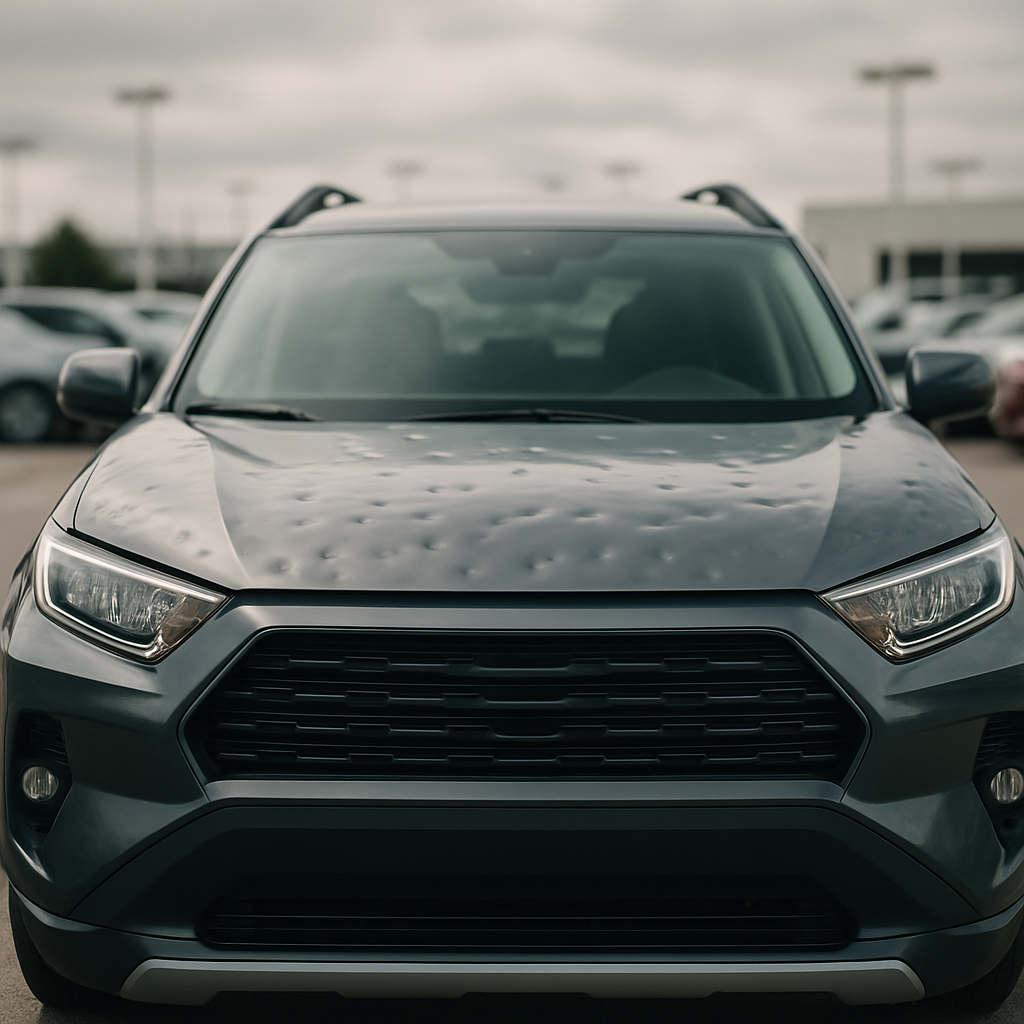
If your car got hit by hail, you’re probably wondering two things: how much is the damage going to cost to fix, and how much value did your car just lose?
The honest answer to the second question depends entirely on what you do next. Unrepaired hail damage can cut a car’s resale value by 10–30%. Properly repaired hail damage via paintless dent repair? Essentially zero impact on value.
Here’s the real math.
Quick answer: how much hail damage devalues a car
- Light hail damage, unrepaired: 5–15% resale value drop. A $20,000 car becomes a $17,000–$19,000 car.
- Moderate hail damage, unrepaired: 15–25% drop. $20,000 becomes $15,000–$17,000.
- Severe hail damage, unrepaired: 25–40% drop, plus the car may be classed as a “hail sale” vehicle at auction, which compounds the loss.
- Hail damage repaired by PDR: 0% impact on resale value. Factory paint preserved. No Carfax record of body work. Buyers and appraisers cannot detect the prior damage.
- Hail damage repaired by body shop (full repaint): 2–8% drop. The car has no longer-original paint, which appraisers and Carfax can detect.
How dealers and appraisers actually assess hail damage
When you trade in or sell a car, the appraiser walks around it under bright lighting, checking specifically for:
- Visible dents — including the round telltale marks of hail damage on the roof, hood, trunk lid, and the tops of fenders
- Paint matching — using their eye (and sometimes a handheld paint depth gauge) to detect whether any panel has been repainted
- Carfax/AutoCheck history — pulling the vehicle history report to see if any body damage was reported through insurance
- Panel condition — checking for filler material, sanded edges, or other body shop signatures
Each one of those four checks affects the appraisal price. Unrepaired hail damage hits all four (visible dents, no paint match issue but obvious deformation). Body shop repairs eliminate the visible dents but light up checks 2 and 4. PDR repairs eliminate the visible dents and pass all four checks.
The real numbers — what your car actually loses
Let’s use real examples from cars we’ve assessed in Sacramento:
Example 1: 2022 Honda Civic, $24,000 trade-in value
- Moderate hail damage, 35 dents across hood/roof/trunk, no repair
- Dealer offered: $19,800 (17% reduction)
- After PDR repair ($1,250): full $24,000 trade-in value restored
- Net gain from PDR: $4,200 minus $1,250 = $2,950 in your pocket
Example 2: 2023 Tesla Model Y, $46,000 private-party value
- Heavy hail damage, 70+ dents including roof and hood
- Trade-in offer (unrepaired): $35,000 (24% reduction)
- After PDR aluminum repair ($2,800, insurance covered): full $46,000 value restored
- Net gain: $11,000
Example 3: 2020 Ford F-150 (aluminum), $32,000 retail value
- Severe hail on hood, roof, bed sides
- Body shop estimate: $11,500, full repaint of 4 panels
- After body shop repair: $30,500 value (paint-history records on Carfax knock 5%)
- After PDR aluminum repair instead ($3,800): $32,000 value retained
- Net difference between repair methods: $1,500 retained value PLUS the F-150 isn’t off the road for 8 days
Does hail damage show on Carfax?
It depends entirely on whether you file an insurance claim and how the claim is processed.
Cases where hail damage appears on Carfax:
- You file a comprehensive insurance claim and the claim notes “hail damage” or “weather event” in the carrier’s reporting
- The vehicle is sold at auction as a “hail sale” or “salvage” car
- A body shop reports the work to data aggregators
Cases where hail damage does NOT appear on Carfax:
- You repair the damage out-of-pocket through PDR (no insurance claim filed)
- The PDR shop doesn’t report to commercial data aggregators (most don’t)
- No body shop work is performed
This is one of the most underrated benefits of PDR repair — even when you do file insurance, the repair itself (being non-body-shop) usually doesn’t add a body work record to Carfax. The claim may show as a weather event, but the resale impact is far smaller than a documented body shop repair.
What if I want to sell or trade with damage still there?
You can — you just pay a heavy penalty.
Dealers calculate trade-in offers by starting at wholesale value and deducting their estimated repair cost plus a profit margin for reconditioning. So if PDR repair would cost $1,500, the dealer will typically deduct $2,500–$3,500 from the offer. The math always favors repairing first, then selling.
Private-party sales with visible hail damage almost always require disclosure in the listing (which deters buyers) and result in lowball offers from buyers who plan to repair it themselves. You’ll typically lose 2–3x what the actual repair would have cost.
The insurance angle — total loss vs repair
If your car’s hail damage estimate exceeds about 70–75% of the vehicle’s actual cash value (ACV), the insurance company may declare it a total loss. You get a payout (the ACV minus your deductible), they take the car, and it gets sold at auction with a “salvage” or “hail sale” title.
Here’s where it gets interesting: body shop hail estimates are often 2–3x what PDR repair would actually cost, because body shops price for repainting every affected panel. If the body shop estimate puts you at 75% ACV but PDR could fix the same car for 25% of the ACV, you can keep your car AND get the cash payout if the insurer agrees to a PDR repair instead.
This is huge. We’ve helped Sacramento drivers keep their cars off the total-loss list multiple times by submitting a PDR estimate as a second opinion. See our hail damage insurance claim guide for the playbook.
How to restore your car’s full value after hail
The path forward depends on severity:
Light hail damage (1–20 dents, small): Get a PDR estimate. Likely under your deductible — pay out of pocket, no insurance claim filed, no Carfax record, full value retained.
Moderate hail damage (20–75 dents): File a comprehensive insurance claim. Get a PDR estimate as a second opinion. Insurer almost always approves PDR (cheaper for them too). PDR repair preserves factory paint and Carfax shows only “weather event” not “body damage.”
Severe hail damage (75+ dents, multiple panels affected): Definitely file the claim. Get the PDR estimate first — before accepting any body shop estimate. PDR can usually save the car at a cost the insurer prefers. Keeps it out of total-loss territory.
Total-loss threatened: Get a PDR second opinion immediately. Don’t sign off on a body shop estimate. We’ve saved Sacramento cars from the total-loss list dozens of times.
Same-area hail history matters too
One factor most drivers don’t realize: cars from regions known for hail (like much of the Midwest, Texas, and increasingly the Sacramento metro during atmospheric river events) carry a slight depreciation penalty even without visible damage. Buyers are more skeptical of cars from hail regions and inspect them more carefully.
If you live in Sacramento and your car had documented hail damage, repaired or not, mentioning it in the sale listing is required for honesty — but listing it as “hail damaged, professionally repaired with PDR, factory paint preserved” reads very differently than “hail damaged” by itself. The PDR distinction matters.
Sacramento-area hail repair
If your car got hit by hail anywhere in Sacramento, Roseville, Folsom, Elk Grove, Davis, or any of our 38 service area cities, we can get you a free PDR estimate within an hour. We bill insurance directly, work on aluminum panels (Tesla, F-150, Rivian included), and have been doing this in Sacramento since 2012.
Text photos of every affected panel to (916) 585-2554. Be careful with body shop estimates — get a PDR estimate first, especially if a body shop suggested totaling your car.
Frequently asked questions
Will Carfax show hail damage?
Sometimes — mostly when an insurance claim is filed and the damage is reported as a covered event. PDR-repaired cars that didn’t go through insurance don’t usually show body work history on Carfax.
How much will a dealer deduct for hail damage?
Typically 1.5–2x what they expect the repair to cost. So a $2,000 PDR repair becomes a $3,000–$4,000 deduction at trade-in. Repair first, then trade.
Is hail damage worth fixing on an older car?
If the PDR repair cost is less than the value drop from leaving it unrepaired, yes. For most cars worth more than $5,000, the math favors repair. For older beaters, it may not be worth it — ask us for an honest assessment.
What if the body shop says my car is totaled from hail?
Get a PDR second opinion immediately. Body shop estimates assume every panel needs repainting; PDR can often save the car for 25–40% of the body shop cost. We’ve reversed total-loss declarations multiple times.
Does insurance cover hail damage for older cars?
Comprehensive insurance covers hail regardless of vehicle age, as long as you have comprehensive coverage on your policy. The payout is capped at the vehicle’s actual cash value (ACV), so older cars with low ACV may not be worth filing a claim on if your deductible is high.
Glass Reflection Dent Repair — Sacramento’s certified PDR specialist since 2012. We bill insurance direct, restore factory paint, and have 135+ five-star Google reviews to show for it. Get your hail damage assessed today: (916) 585-2554 or request a quote online.
)
No comment