A bad paintless dent repair (PDR) tech can turn a $150 repair into a $400 paint job — or a $300 repair into a $1,200 panel replacement. Picking the right shop is one of the most important calls you’ll make as a car owner.
Here’s the 10-point checklist we’d use if we were customers. Some of these are obvious, some aren’t.
Why this matters more than people realize
PDR is a precision craft. The right tool at the right angle with the right pressure brings the metal back to perfect. The wrong tool, the wrong angle, or too much pressure stretches the metal, leaves a high spot, or damages the paint from behind. Once a panel is damaged by bad PDR work, it’s usually a body shop fix to recover — far more expensive than the original repair.
The good news: vetting a PDR shop takes about 10 minutes of careful questions. Here’s exactly what to ask.
The 10-point checklist
1. How many years has this tech done ONLY PDR?
Important word: “only.” Many body shops list PDR as a service but their primary work is paint. A tech who spends 5% of their time on PDR isn’t a PDR tech — they’re a body tech who occasionally tries dent work.
Look for: minimum 5 years of PDR-only work. 10+ is ideal. (We’ve been Sacramento PDR-only since 2012.)
Red flag: “We do dent repair and paint” or “We do everything.” That usually means the PDR work is a side service.
2. Are they aluminum-certified?
Critical if you drive a Tesla, Ford F-150, Rivian, Lucid, or some German luxury cars. Aluminum requires different tools and heat-controlled techniques.
Look for: explicit confirmation of aluminum certification. The tech should be able to describe what’s different about aluminum work without hesitating.
Red flag: “Sure, we can do aluminum, no problem” without specifics. That usually means they’ll try the same approach as steel — which damages aluminum.
3. What’s the workmanship warranty?
The standard for a quality PDR shop is a lifetime workmanship warranty. That means if a repair they did ever comes back (the dent reforms, a high spot appears later, anything related to the original work), they fix it again at no charge.
Look for: lifetime workmanship warranty in writing.
Red flag: 30-day or 90-day warranty. A 90-day warranty signals that the shop doesn’t fully trust their own work. A good PDR repair should hold forever.
4. Can they quote a real price from a photo?
A pro can quote almost any dent from one or two photos. A junior tech or untrained shop will give “starting at $X” ranges that double on arrival.
Look for: a specific number after they see the photo. (“That’s $175 to fix” not “It’ll be somewhere between $100 and $350.”)
Red flag: “We’ll need to see it in person to give a price.” This often means they’re going to upcharge after they have your car.
5. What method do they use — rods, glue, or both?
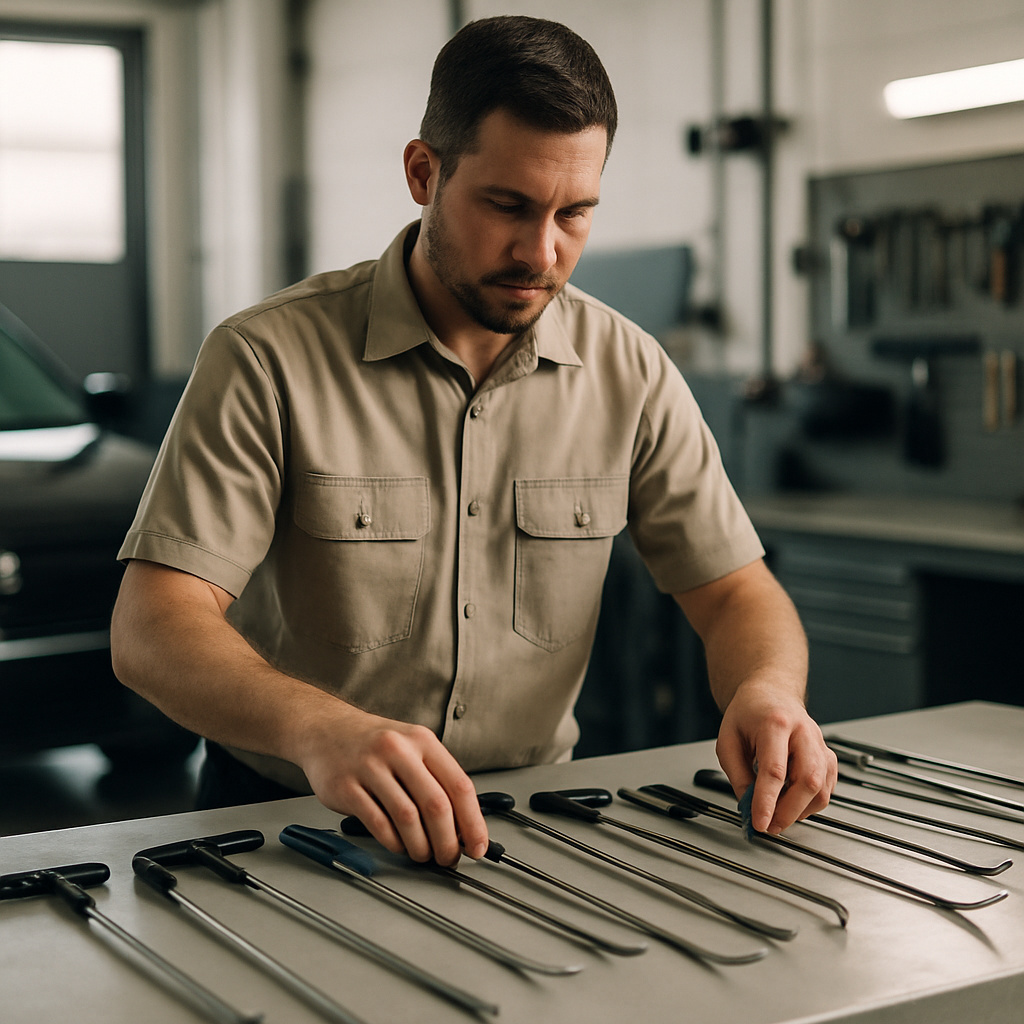
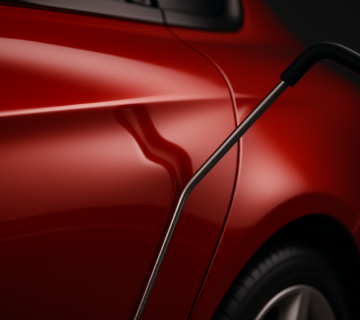
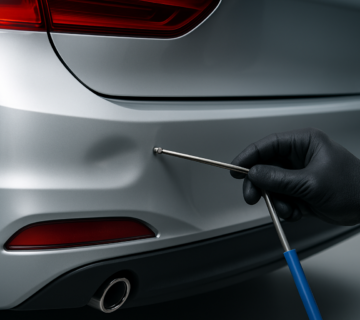
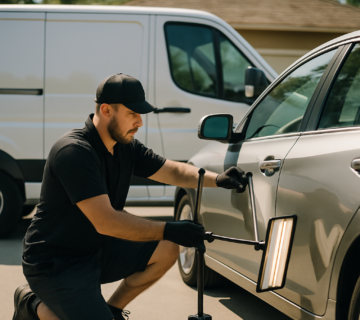
There are two PDR methods: rod-and-tool work (pushing the dent out from inside the panel) and glue-pulling (sticking a tab to the outside and pulling). Quality shops use rod-and-tool as the primary method and glue-pulling only as a last resort for panels that can’t be accessed from behind.
Glue-pulling-only shops are cheap and fast but the work is rarely as clean. Glue work tends to leave small high spots and doesn’t reshape the metal as precisely.
Look for: “We use rods as the primary method, glue when needed.”
Red flag: “We use glue pulling — it’s the modern method.” It’s the cheap method, not the modern method.
6. How many Google reviews do they have, and what do they say?
Count and content both matter.
Look for:
- At least 50 Google reviews
- Average rating 4.7+ stars
- Reviews that mention specific details (the type of car, the type of dent, the technician’s name, the result)
- Recent reviews (within last 90 days)
- The shop responds professionally to any negative reviews
(We have 135+ five-star Google reviews from real Sacramento drivers.)
Red flag: generic reviews (“Great service, would recommend!” with no specifics), reviews clustered in one week (likely fake), no recent reviews, or unprofessional responses to negative ones.
7. Do they have a physical address?
Every legitimate PDR business has a brick-and-mortar address listed publicly. Even mobile-only operations have a registered base of operations.
Look for: a physical address you can verify on Google Maps.
Red flag: only a phone number, no address, or an address that turns out to be a residential house with no signage. Could be a fly-by-night operation.
8. Will they let you watch the repair?
Quality shops are proud of the work and happy to let you watch. Bad shops don’t want you to see what’s happening.
Look for: “Yes, absolutely — you can watch every step.”
Red flag: “Customers usually wait in the waiting room” or “It’s safer if you don’t watch.”
9. How do they handle insurance work?
If your dent is hail damage or otherwise insurance-covered, you want a shop that bills the insurance directly. This saves you from fronting money and waiting for reimbursement.
Look for: “We bill the insurance directly. You pay your deductible to us; they pay us the rest.”
Red flag: “You pay us, then claim it from your insurance yourself.” That’s a hassle.
See our Sacramento hail insurance claim guide for the details on how insurance PDR claims work.
10. Will they tell you when PDR ISN’T the right choice?
This is the secret-handshake question. A good PDR shop will sometimes tell customers, “Your dent isn’t a great PDR candidate — you should go to a body shop.” A bad shop takes every job and either does it badly or upcharges.
Look for: a tech who’s willing to refer you elsewhere when your dent isn’t a PDR fit.
Red flag: “We can fix anything.” No PDR shop can fix anything. The shops that say so are misrepresenting their capabilities.
Red flags that should make you walk away
- “Starting at” pricing with no specific quote after seeing a photo. The quote always doubles.
- Demands payment upfront before seeing the car. Standard practice is payment after work is approved.
- Wants you to bring the car to a shop when they advertise mobile service. Defeats the whole point.
- No warranty or “30-day” warranty. Real PDR holds forever.
- Less than 50 Google reviews. Hard to evaluate quality.
- Recent reviews mention surprise upcharges, cancellations, or bad paint work. Pattern not coincidence.
- Won’t say whether they’re aluminum-certified. Especially critical for Tesla/F-150 owners.
- Estimates are 50% cheaper than other quotes you got. They’re going to upcharge or use cheap glue methods.
- Doesn’t have a website or social presence. A real PDR business invests in being findable.
What a quality shop looks like in practice
For comparison, here’s how Glass Reflection Dent Repair stacks against the 10-point checklist:
- Years PDR-only: 12+ years (since 2012, PDR is our only service)
- Aluminum-certified: Yes — trained on Tesla, F-150, Rivian, German aluminum panels
- Warranty: Lifetime workmanship
- Photo quotes: Yes — honest single-number quotes within an hour
- Method: Rod-and-tool primary, glue only when access requires it
- Google reviews: 135+ five-star
- Physical address: 5816 Roseville Rd, Sacramento, CA 95842
- Watch the work: Yes — you can watch every step
- Insurance billing: Direct insurance billing for hail and covered work
- Honest about PDR limits: We refer dents that aren’t PDR fits to body shops we trust
How to actually interview a PDR shop in 10 minutes
Send a photo and have this 10-minute conversation:
- “Here’s my dent. What’s it going to cost to fix?” (specific number, not range)
- “How long will it take?” (specific time, not range)
- “Are you aluminum-certified?” (if you drive Tesla/F-150/Rivian)
- “What’s your warranty?” (lifetime workmanship is the standard)
- “Can I watch the repair?” (yes is expected)
- “Do you bill insurance directly?” (for hail or covered work)
If they pass all six, book. If they hedge on more than one, keep looking.
Frequently asked questions
How can I tell if a PDR tech is good before the job?
The questions above are the fastest screen. Beyond that, look at their portfolio — quality shops post photos of completed repairs on their website or Google Business Profile. Ask to see a before/after of a dent similar to yours.
What’s the average price for paintless dent repair?
Sacramento area: door dings $75–$125, standard dents $125–$275, creases $250–$550, aluminum panels add 25–40%. Full pricing guide here.
Is mobile dent repair as good as shop-based PDR?
Yes — in fact, mobile is the standard for most PDR work because the techniques and tools are the same regardless of location. We do 95% of our jobs in customer driveways. Shop work is only needed for very large multi-panel jobs.
Can I trust a PDR shop that’s only been in business for a year?
Caution. A 1-year-old shop might have a great tech with decades of experience under their belt, or it might be a new operator still learning. Ask the years-PDR-only question (not years-in-business). If the tech has 10+ years of PDR experience even at a new shop, it’s likely fine.
What’s a fair price to pay a PDR shop?
If you got 3 quotes and they’re all in roughly the same range, the middle quote is usually fair. If one quote is 50% lower than the others, that’s a red flag — not a deal.
Glass Reflection Dent Repair — Sacramento’s PDR-only specialist since 2012. (916) 585-2554. Text a photo or use the online quote form. We come to you across 38 cities in the Sacramento metro.


[…] is either inexperienced or willing to take your money on a job they can’t deliver. Our PDR shop vetting checklist covers exactly this — the willingness to say no is a sign of a good […]